 Skip to content
The Ecommerce Guide to Multicultural Holidays in 2026
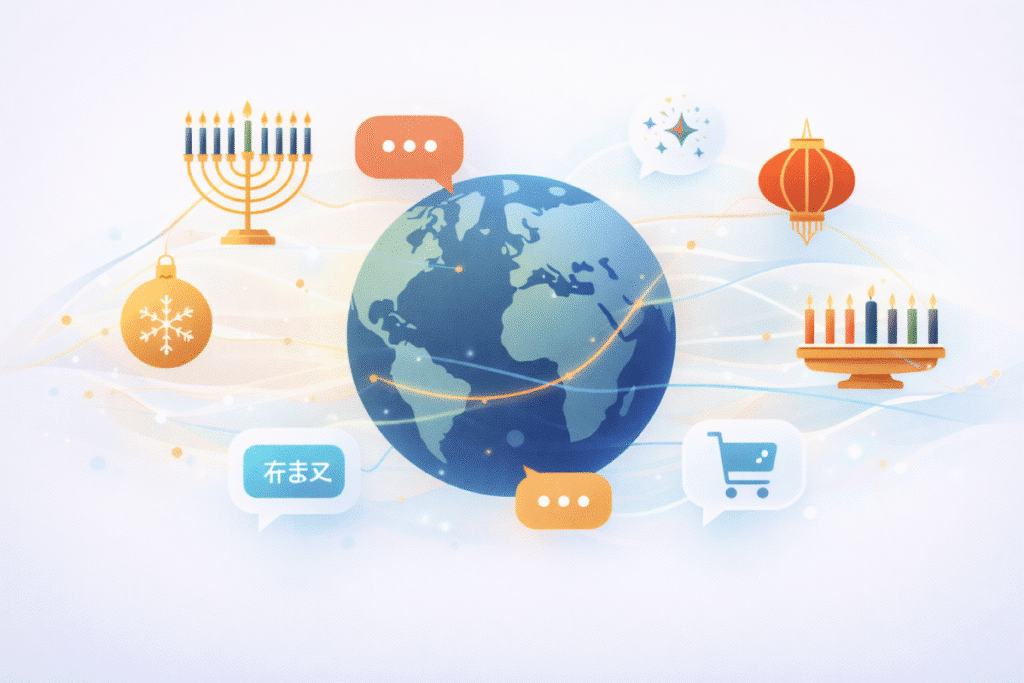
The holiday shopping season isn’t slowing down. It’s shape-shifting.
Deloitte’s 2025 holiday forecast projected U.S. ecommerce sales between $305 billion and $310.7 billion—a 7% to 9% increase year over year—even as overall retail growth softened to just 2.9% to 3.4%. Salesforce’s post-season data confirmed the trend: global online holiday sales hit a record $1.29 trillion, with U.S. digital sales reaching $294 billion and year-over-year growth of 4% domestically and 7% globally.
But here’s the number that should reframe your entire holiday playbook: AI and agents powered 20% of all online retail sales during the 2025 holiday season, driving $262 billion in revenue through personalized recommendations, multilingual support, and deeper customer engagement, according to Salesforce.
The takeaway? The holiday season is no longer just about discounts and shipping deadlines. It’s about reaching the right customer, in the right language, on the right channel—and doing it at scale. If your brand sells to more than one market, this guide is for you.
Here are five considerations for a successful multicultural holiday season in 2026.
1. The Nuances of Different Markets (and Why They Matter More Than Ever)
In the United States, the holiday shopping season still revolves heavily around Christmas. Santa’s still in the mall. Trees still adorn storefront windows. And the majority of promotional calendars are timed around December 25.
That’s not wrong—but it’s incomplete. According to Pew Research, 90% of Americans celebrate Christmas, but the way they celebrate varies enormously. Nearly half treat it as primarily a religious holiday, while the majority celebrate it as a cultural tradition. And that’s just one holiday in one country.
Globally, the last quarter of the year is packed with holidays that drive meaningful commerce:
- Hanukkah
- Kwanzaa
- Boxing Day (a massive retail event across the UK, Canada, and Australia)
- Winter Solstice and Yule
- Las Posadas
- Ōmisoka (Japan’s New Year’s Eve tradition)
- Diwali (which increasingly overlaps with early holiday shopping windows)
- Singles’ Day and Double 12 (still dominant in Asia-Pacific markets)
- New Year’s Eve
The point isn’t to incorporate every holiday into your strategy. It’s to understand the ones that matter to your customers and get the details right. Which holidays are gift-giving occasions? Which ones center on food, family, or spiritual observance? What greetings are appropriate—and which ones fall flat?
A holiday email promoting “gifts for everyone on your list” won’t land if the holiday in question isn’t a gift-giving occasion. And sending a generic “Happy Holidays” message to a market that primarily celebrates Diwali or Ōmisoka can feel tone-deaf rather than inclusive.
Also worth considering: “just for fun” holidays. A home goods brand might run a barware promotion on National Bartender Day. A phone brand might leverage National Call a Friend Day. These micro-moments can drive engagement when they’re authentic and well-timed.
2. Seasons, Weather, and the Hemisphere Problem
This one sounds obvious until you get it wrong.
While shoppers in Chicago are reaching for parkas and snow boots, customers in Sydney are shopping for swimsuits and sunscreen. A holiday email with the headline “Baby It’s Cold Outside!” resonates in Illinois—but not in Florida, and certainly not in Australia.
If your brand sells apparel, housewares, outdoor gear, or anything remotely seasonal, your holiday campaigns need to account for climate differences across your key markets. That means segmenting campaigns not just by country, but by region. A single “winter wonderland” creative doesn’t work when a significant portion of your customers are heading to the beach.
This is also where AI-powered personalization starts to earn its keep. Dynamic content blocks that adjust imagery and messaging based on a customer’s location can solve this problem at scale—without requiring your team to build dozens of campaign variants manually.
3. Your Website Needs to Be Ready for Global Traffic (Not Just More Traffic)
Online holiday shopping grew again in 2025. Salesforce reported a 12% year-over-year increase in global online sales during the last two weeks of December alone, and Adobe tracked $253.4 billion in U.S. ecommerce sales from November through December. Mobile commerce accounted for 56% of online holiday sales globally, up from previous years.
Your website isn’t just getting more traffic during the holidays—it’s getting more diverse traffic, from more time zones, on more devices, with higher expectations. Here’s how to prepare:
Deploy AI-Powered Multilingual Support
Gartner found that 54% of organizations now use some form of chatbot or conversational AI for customer-facing interactions. During the 2025 holidays, Salesforce reported that shoppers used retailers’ AI agents for customer service 126% more than in the two months prior—and AI-powered service conversations jumped 66% from November to December.
A multilingual AI assistant on your site means global visitors get answers in their language, any time of day. Your live agents can focus on the complex, high-value interactions that actually require a human touch.
Meet Customers on Their Preferred Channels
Global consumers increasingly expect to interact with brands through messaging apps like WhatsApp, WeChat, and LINE—not just email and live chat. Forrester’s 2025 research on translation management systems highlights that modern localization now spans websites, apps, support flows, and messaging platforms. If your customers are on WhatsApp, your brand should be, too.
Leverage Ratings, Reviews, and Q&A
Social proof remains one of the strongest drivers of holiday purchase decisions. Shoppers researching gifts want to see what real buyers think—especially when purchasing across borders, where trust signals carry extra weight. DHL’s 2025 cross-border ecommerce research found that international shoppers are more likely to rely on reviews and social proof when buying from unfamiliar brands. Make sure your product pages feature robust ratings, reviews, and Q&A sections—ideally translated into the shopper’s language.
Offer the Right Payment Methods
Payment preferences vary dramatically by market. Digital wallets now account for 53% of global ecommerce transactions, according to Capital One Shopping research. In some markets, buy now, pay later (BNPL) is standard. In others, cash on delivery still dominates. Adobe projected $20.2 billion in BNPL spending during the 2025 holiday season alone. Understand what’s trusted in your key markets and integrate accordingly—Apple Pay, Google Pay, Stripe, Klarna, Mercado Pago, or local alternatives.
4. AI-Powered Translation Is No Longer Optional—It’s the Growth Lever
This is where the game has fundamentally changed.
Cross-border ecommerce is now a $1.47 trillion market, growing at a compound annual rate above 15%. About 59% of global consumers buy from retailers outside their own country, according to recent industry data. And the cross-border ecommerce market is growing 28% faster than domestic ecommerce overall.
But here’s the friction: language. CSA Research’s landmark study of 8,709 consumers across 29 countries found that 76% of online shoppers prefer to buy products with information in their native language. Forty percent said they will never buy from websites in other languages. If you’re not localizing, you’re leaving up to 40% of your addressable market on the table.
The expectations extend well beyond product pages. Consumers want native-language communication across every touchpoint: support emails, live chat, messaging apps, SMS, Q&A responses, and even post-purchase follow-ups. CSA Research also found that 74% of consumers are more likely to repurchase from a brand that provides post-sales support in their language.
This used to be a resource-intensive challenge. Today, AI has changed the economics entirely.
Forrester’s inaugural Wave evaluation of Translation Management Systems (Q3 2025) makes it clear: the localization market is at an inflection point. AI isn’t just translating words—it’s automating workflows, adapting content for cultural context, and enabling brands to localize at a pace that was impossible even two years ago. The evaluation covered major players like Unbabel, Phrase, Smartling, and others, all of whom are integrating AI agents, LLMs, and machine translation into increasingly sophisticated platforms.
Gartner’s research on AI-enabled translation services reinforces this trend, tracking the rapid maturation of tools that combine machine translation with human-in-the-loop quality assurance—a critical capability for brands that can’t afford to get tone or nuance wrong during high-stakes holiday campaigns.
For brands operating in Salesforce, solutions like Translation Studio from 1440 make this accessible without leaving the platform. The ability to translate customer communications, marketing content, and service interactions from within your existing CRM means faster time to market and a consistent brand voice across every language.
5. Shipping Promises Are Global Promises Now
The holiday shopping window keeps stretching. Amazon’s fall Prime Day events, followed by Target and Walmart promotions, have trained consumers to start early. The National Retail Federation has found that a significant share of shoppers now begin purchasing well before Black Friday to avoid price hikes and stockouts.
But there are still plenty of last-minute buyers. And regardless of when they shop, consumers expect their orders to arrive on time. For global brands, that means navigating a complex web of international shipping, customs, and local delivery networks.
DHL’s 2025 ecommerce research found that cross-border shoppers will abandon their cart if they encounter unexpected customs charges, and 68% of consumers say they’d pay more for guaranteed cross-border delivery before December 24. Average international delivery times in major trade corridors have improved to six to eight days (down from ten-plus in 2022), but customs delays still account for over 20% of late international deliveries.
Transparency matters. Show estimated delivery dates. Be upfront about duties and taxes. And make sure your fulfillment infrastructure can deliver on the promises your marketing makes.
The Bigger Picture: AI Is Rewriting the Multicultural Holiday Playbook
The 2025 holiday season was a proof point. Salesforce found that retailers who deployed their own AI agents saw a 59% higher growth rate—averaging 6.2% year-over-year sales increases compared to 3.9% for those who didn’t. AI agents handled 142% more customer tasks during the holidays than in the prior two months, and AI-powered service conversations grew 66% from November to December.
Meanwhile, AI-referred traffic converted at a rate 700% higher than social media traffic, according to Salesforce’s pre-holiday data. And a third of U.S. consumers reported incorporating generative AI tools into their holiday shopping process, per Deloitte.
For multicultural commerce, the implications are enormous. AI translation and localization tools mean you can launch holiday campaigns in ten languages without hiring ten translation teams. AI-powered chatbots can resolve customer service issues in a shopper’s native language at 2 a.m. on Boxing Day. Dynamic content can adjust messaging, imagery, and offers based on a customer’s market, language, and cultural context—automatically.
This isn’t about replacing human judgment. It’s about scaling it. The brands that thrived in 2025 didn’t just have better discounts—they had better infrastructure for reaching a global, diverse customer base.
Get Ready for a Smarter Holiday Season
The holidays will be here before we know it. And the window for preparation is shorter than it feels.
The brands that win in 2026 won’t just be the ones with the best products or the deepest discounts. They’ll be the ones that understand their customers’ holidays, speak their customers’ languages, and show up on their customers’ preferred channels—with the infrastructure to deliver on every promise they make.
AI has made all of this more achievable than ever. The question is no longer whether you can afford to localize your holiday strategy. It’s whether you can afford not to.