 Skip to content
Why Multilingual AI Is the Missing Piece in Your Agentforce Rollout
And why social commerce is making it urgent
Something interesting happened last year. Agentforce went from pilot-phase curiosity to the fastest-growing organic product in Salesforce’s history. By Q3 FY2026, the platform had reached 18,500 customers, with over 9,500 on paid plans. Agentforce ARR hit $540 million—a 330% year-over-year increase. Customers in production grew 70% quarter-over-quarter.
That’s not experimentation anymore. That’s deployment at scale.
But as teams push Agentforce into production across regions, a gap keeps showing up: language. An AI agent that resolves a billing dispute in English but can’t handle the same conversation in Portuguese, Arabic, or Korean isn’t a global solution—it’s a local one with global ambitions.
That’s the problem we set out to solve. And with social commerce now crossing $100 billion in the U.S. this year, with customer conversations happening across TikTok, Instagram, WhatsApp, and a dozen other channels, the urgency has never been higher.
The Global Customer Isn’t Waiting
Let’s start with what’s changed. Two years ago, social commerce was a line item in a trend report. Today it’s a $100 billion channel in the U.S. alone, growing at 18% year-over-year. TikTok Shop is projected to surpass $20 billion in sales this year, commanding nearly a quarter of the social commerce market by 2027. Instagram Reels views for luxury brands grew 234% in the first half of 2025. Half of all U.S. social shoppers are expected to make purchases on TikTok by 2026.
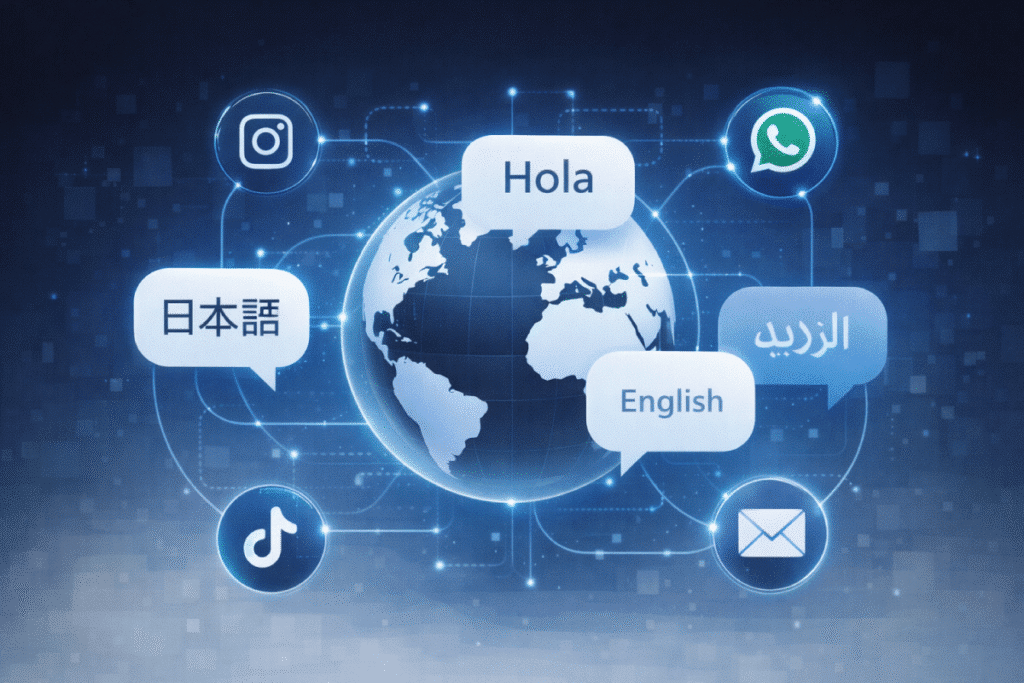
The customer journey has fundamentally changed. Someone discovers a product in a TikTok livestream, asks a question in an Instagram DM, completes a purchase on WhatsApp, and files a support request over email—all in a single day. Often not in English.
According to Salesforce’s State of the Connected Customer report, 71% of customers expect companies to communicate in their preferred language, and 81% expect faster service as technology advances. Meanwhile, CIOs rank customer service as the number-one use case for agentic AI, and the average number of Agentforce-led service conversations grew 22x in the first half of 2025.
The demand is there. The AI agents are there. But when those agents can only operate in one language, you’re leaving revenue, satisfaction, and loyalty on the table—especially in the channels where social commerce is booming.
What We Built (and Why It’s Different)
At 1440, we’ve been building customer engagement and translation solutions inside Salesforce since 2009. With our latest integration, we now offer a complete multilingual stack for Agentforce—covering both AI-driven translation and human-in-the-loop workflows for high-value or regulated scenarios.
Here’s what that looks like in practice:
- Real-time AI translation of Agentforce conversations across chat, SMS, WhatsApp, Instagram DMs, TikTok Shop, and more—powered by engines like TransPerfect, DeepL, and ChatGPT
- Human-in-the-loop workflows for regulated industries, high-touch accounts, and brand-sensitive communications where AI alone isn’t enough
- Knowledge Article translation that unlocks Agentforce responses in any language—so AI agents surface accurate, localized content instead of defaulting to English
- Seamless agent handoff with translated context so human agents pick up the conversation without losing history or nuance
- Supervisor oversight in any language, in real time —critical for quality assurance and compliance monitoring
- Email-to-Case translation automation for inbound support at scale
- Support for 200+ languages, including Salesforce UI, Lightning, and Experience Cloud—all native, no middleware, no external tools
The key word there is native. Everything runs inside Salesforce. Language detection is automatic. Translation happens in real time. Data stays inside the platform’s trust layer. There’s no separate UI, no third-party hop, no latency introduced by external tooling.
Where Social Commerce Makes This Urgent
This isn’t just a service play. It’s a commerce play.
TikTok Shop processed over $500 million in sales during Black Friday/Cyber Monday 2025 alone, with 760,000 livestream sessions generating 1.6 billion views. Instagram Shopping continues to grow as brands lean into Reels for product discovery. Facebook Marketplace still holds the largest social buyer base in the U.S. WhatsApp is becoming a primary commerce and service channel across Latin America, Europe, and Asia.
For global brands selling across these platforms, the customer journey now starts in a short-form video and ends in a support conversation. Both need to happen in the customer’s language.
1440’s Salesforce-native channel integrations—including TikTok Shop via Salesforce’s BYOC (Bring Your Own Channel) framework, Instagram DMs through Digital Engagement, and WhatsApp—mean that product inquiries, order issues, and post-purchase support all flow directly into Service Cloud. Combined with Translation Studio, every one of those conversations can be handled in the customer’s native language, whether it’s managed by an Agentforce agent or a human representative.
This is the operational reality of social commerce at scale: discovery happens anywhere, transactions happen everywhere, and service needs to be seamless across all of it—in any language.
Why Native Salesforce Integration Matters More Than Ever
Enterprises running Agentforce are investing in a tightly integrated stack: Data 360 for the data foundation, Flow for automation, MuleSoft for orchestration. Adding a disconnected translation layer introduces latency, data fragmentation, and governance gaps—exactly the kind of problems that 96% of IT leaders say will determine whether AI agents succeed or fail.
Translation Studio works across standard objects, custom objects, tasks, emails, live chats, Einstein Bots, Agentforce conversations, Knowledge Articles, metadata, and email templates. Everything stays inside Salesforce. For regulated industries—financial services, healthcare, public sector—this native architecture also simplifies compliance. TLS encryption and no-trace data policies are built in, not bolted on.
And for organizations already seeing results with Agentforce, the business case is clear: Salesforce Service Cloud customers using embedded AI translation report up to 28% faster case resolution times. When your agents and AI are working from the same translated context, the entire operation moves faster.
The Numbers That Should Get Your Attention
If you’re weighing whether multilingual AI belongs in your 2026 roadmap, here’s the landscape:
- The AI customer service market is projected to grow from $12 billion in 2024 to nearly $48 billion by 2030
- Gartner forecasts that conversational AI will reduce contact center labor costs by $80 billion by 2026
- Organizations are deploying an average of 12 AI agents today, with that number projected to grow 67% within two years
- 83% of organizations report that most or all teams have adopted AI agents
- U.S. social commerce will exceed $100 billion this year, with TikTok Shop alone surpassing $20 billion
- 76% of online shoppers prefer to buy products with information in their native language, and 40% will never purchase from sites in other languages
- Gartner ranks machine translation as one of the highest-impact AI use cases in customer service
As agent fleets scale, so does the need for consistent, accurate multilingual output—not just in customer-facing conversations, but in internal knowledge, supervisor dashboards, and reporting. The companies that treat language as infrastructure rather than an afterthought are the ones that will scale globally without scaling costs linearly.
Who This Is For
If any of these describe your team, this is worth a closer look:
- You’re scaling Agentforce globally and need multilingual AI agents that work across chat, messaging, and social channels
- You’re running social commerce on TikTok Shop, Instagram, or WhatsApp and managing customer conversations in multiple languages
- You operate in a regulated industry where human oversight of AI-generated translations is required
- You’re expanding into new markets without hiring language-specific support teams
- You’re consolidating your tech stack around Salesforce and want to eliminate external translation tools
The Bottom Line
Agentforce is moving fast. Social commerce is moving faster. And your customers are already having conversations in dozens of languages across channels that didn’t exist three years ago.
The question isn’t whether your AI agents need to be multilingual. It’s how quickly you can get there without bolting on complexity, compromising brand voice, or breaking your Salesforce architecture.
That’s what we built 1440 to do. And with Agentforce, we can now do it across every channel, every language, and every stage of the customer journey—all inside Salesforce.